Louisville, Ohio: 4-Star Schools, a $235,000 Median, and Room to Negotiate
Louisville homes sold at a median price of $235,000 in March 2026, per Stark County MLS data, and on that month’s medians it was the least expensive entry into a 4-star-or-better school district anywhere in Stark County. Louisville City Schools earned a 4-star overall rating on the 2024-25 Ohio School Report Cards, the same overall mark as Perry Local, whose median ran $252,000, and one notch below North Canton’s 5 stars at $273,000. The caveat comes first here: March’s figure rests on 9 closed sales, below the 10-transaction threshold I’d want before calling a number solid, so treat it as directional.
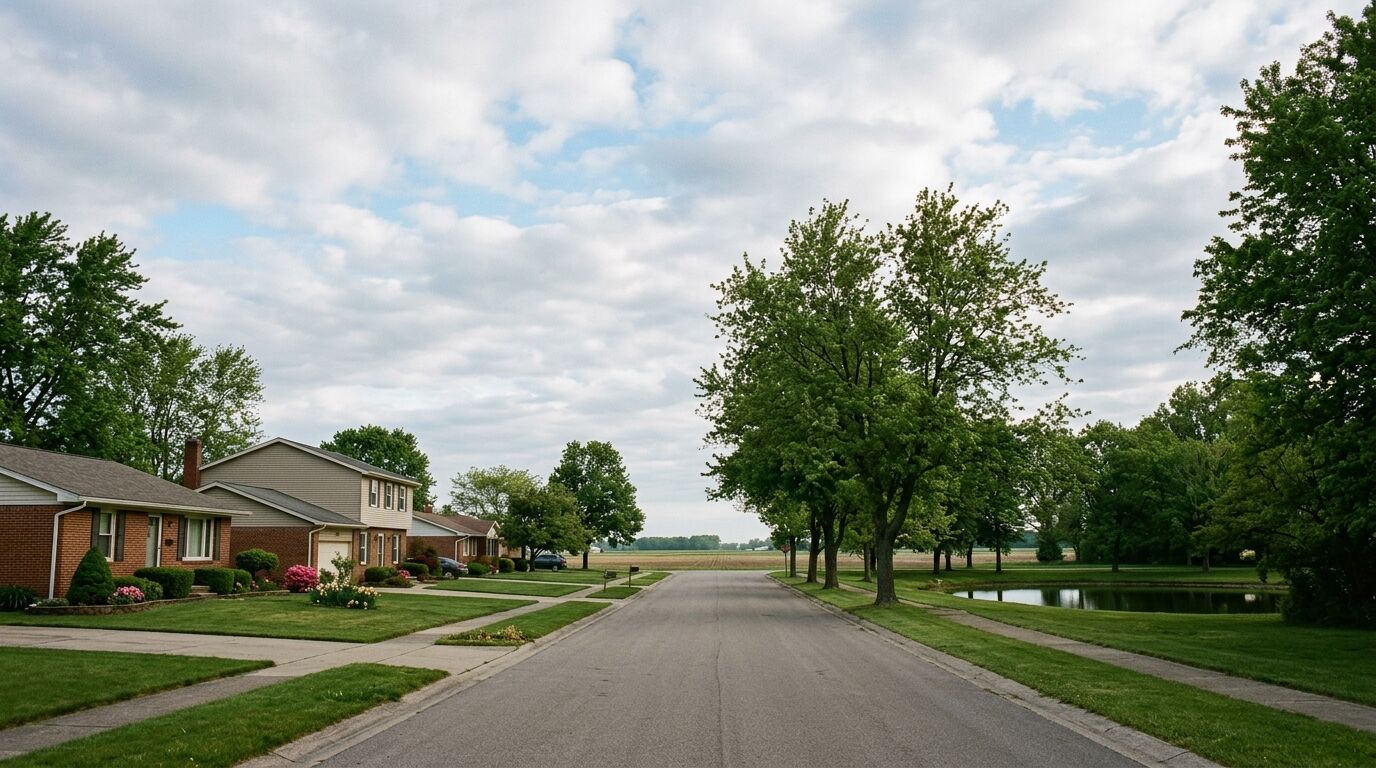
Louisville (locals say LEWIS-ville) is a small city of about 9,602 people roughly 7 miles northeast of Canton, settled in 1834 and officially “The Constitution Town” by City Council resolution since 1957. It runs its own school district, its own park system of more than 120 acres, and a downtown where State Routes 44 and 153 cross. Buyers usually find it after getting outbid in North Canton or Plain Township, then discover the schools hold up and the commute barely changes.
Market data: Stark County MLS, March 2026. Tax rates: Stark County Auditor CAMA, 2025 tax year. Last updated: 2026-06-03.
Quick Facts: Louisville, Ohio
| Metric | Louisville (Louisville CSD) |
|---|---|
| Median Sale Price (Mar 2026) | $235,000* (directional, n=9) |
| Median Price Per Sq Ft | $172 |
| Avg Days on Market | 60.8 days |
| List-to-Sale Price Ratio | 101.0% |
| Closed Sales (Mar 2026) | 9 |
| School District | Louisville City Schools (4 stars, 2024-25) |
| Property Tax Rate | 48.42 effective mills (on taxable value) |
| Annual Tax on $200K Home | ~$3,389 before credits |
| City Income Tax | 2% (credit capped at 1.2%) |
| ZIP Code | 44641 |
| Population | 9,602 (ACS 2024) |
| Distance to Downtown Canton | ~7 miles (13 minutes via SR-153) |
*Based on 9 closed sales in March 2026. Treat as directional; the sample is below standard statistical thresholds.
Why Buyers Choose Louisville
The school math is the headline. Louisville City Schools posted a 4-star overall rating on the 2024-25 Ohio School Report Cards, with 5-star components in both Gap Closing and Graduation and a 98.2 percent four-year graduation rate. Getting that report card in Jackson Local costs a $360,500 median. In North Canton, $273,000. In Louisville, the March 2026 median was $235,000. Even against Perry Local, the county’s other reliable 4-star value at $252,000, Louisville came in $17,000 lighter on the month’s numbers. Small sample noted, but the price tier itself is consistent with what I see in this market week to week.
The second draw is time to think. Louisville listings averaged 61 days from listing to contract in March, the longest among the districts I track and 12 days past the county average of 49. In Plain Township or Massillon, a well-priced home can be gone before your second showing. Louisville’s pace gives a deliberate buyer, especially one selling another home first, an actual window to work with. The flip side sits right in the same data: the median sale closed at 101 percent of list price. Homes that hit the market priced right are getting bid past asking while the mispriced ones supply the long average. A 9-sale month produces odd-looking combinations like that, and I’d rather show you the tension than smooth it over.
Third, the town itself is a self-contained small city rather than a subdivision with a ZIP code. There’s a walkable core at the SR-44/SR-153 crossing, a parks system that outbuilds towns twice its size, and a September festival week built around an identity no other Ohio town can claim.
Real Estate Market Snapshot
Louisville CSD recorded 9 closed sales in March 2026 at a $235,000 median, $172 per square foot, with 26 new listings entering the market during the month. That new-listing count against single-digit closings suggests buyers will have more to choose from heading into summer than the March sales count implies. Per-square-foot pricing landed within a few dollars of North Canton’s $174, which says the discount is mostly in home size and lot, not in what the market pays for finished space.
As a licensed REALTOR® with the Stark Trumbull Association of REALTORS® and NAR e-Pro certification, I’ll repeat the honest caveat: 9 sales is a directional sample. What the directional read shows is a market priced below Plain Township and well below North Canton, moving slower than both, and rewarding sellers who price correctly with full-price-or-better outcomes.
| Area | Median Price (Mar 2026) | Avg DOM | $/Sq Ft | List-to-Sale | YoY Change | Tax Rate |
|---|---|---|---|---|---|---|
| Louisville CSD | $235,000 | 60.8 days | $172 | 101.0% | N/A (n=9) | 48.42 mills |
| Plain Township | $249,750 | 43.9 days | $154 | 100.0% | +1.9% | 41.65 mills |
| North Canton | $273,000 | 45.9 days | $174 | 99.3% | +7.1% | 50.12 mills |
| Stark County (overall) | $210,000 | 49.2 days | $150 | 100.0% | +5.0% | varies |
Source: Stark County MLS data, March 2026; Stark County Auditor CAMA, 2025 tax year. MLS data is reported by school district. Louisville’s year-over-year change is omitted due to insufficient prior-year sample. District-level active inventory is not available from the MLS stats tool.
Schools and Education
Louisville City Schools earned 4 stars overall on the 2024-25 Ohio School Report Cards, an “exceeds state standards” rating, per reportcard.education.ohio.gov. The components: 4 stars in Achievement, 3 in Progress, 5 in Gap Closing, 5 in Graduation with a 98.2 percent four-year graduation rate, 4 in Early Literacy, and 3 in College, Career, Workforce and Military Readiness. District enrollment is about 2,744, and the teaching staff averages 20 years of experience, on the senior end for Stark County districts.
The buildings are newer than the town’s housing stock by a wide margin. Louisville Elementary opened in 2012 and consolidated three older elementary buildings, Louisville Middle School opened in 2004, and North Nimishillen Elementary handles preschool through grade 2. Louisville High School, home of the Leopards, dates to 1964 with renovations since. Students also have career-technical pathways through the Stark County Area Joint Vocational School District. For private education, St. Thomas Aquinas, a Catholic school serving grades 6 through 12, sits on Reno Drive NE inside the city.
One comparison point worth naming: Plain Local, the district most Louisville shoppers cross-shop on price, rated 3.5 stars overall in the same report card cycle. Louisville is the rare Stark County market where the cheaper home comes with the higher-rated district. Ratings change annually, so verify current numbers at reportcard.education.ohio.gov before weighting them heavily in an offer decision.
What It’s Like to Live Here
The Constitution Town story is real history, not a marketing line. In 1952, Louisville resident Olga T. Weber petitioned the mayor to proclaim the first local Constitution Day on September 17. She then took the idea to the Ohio legislature, and from there to Congress, which designated the national Constitution Week that President Eisenhower signed. City Council made the nickname official on April 15, 1957, and four state historical markers at the city’s entrances document the sequence, per the city’s history page at louisvilleohio.gov. Every September the city runs Constitution Days, a week of events ending in a grand parade through downtown.
For a city of 5.7 square miles, the park inventory is genuinely oversized: more than 120 acres across seven named parks, per louisvilleohio.gov. Mary C. Metzger Park covers 90-plus acres with a dog park, soccer and ball fields, and a walking trail. Wildwood Park adds 30 acres and a disc golf course. Aljancic Park has a splash pad and pickleball courts, Constitution Park has a stocked fishing pond, and Wilson Park has a skate park. The Louisville Public Library on South Nickelplate runs a public makerspace alongside the usual collections. The east branch of Nimishillen Creek threads through town, and the surrounding land flattens quickly into farm country, which is why sweet corn season is a local event.
The economic base skews hands-on. Manufacturing is the city’s largest employment sector at 717 workers per ACS 2024 data, anchored by operations like H-P Products, which has built central vacuum systems in Louisville since 1945. And the town holds one genuinely unexpected piece of history: Augustus D. Juilliard, whose estate funded The Juilliard School in New York, grew up on a farm near Louisville, per juilliard.edu.
Location and Commute
Louisville sits about 7 miles northeast of downtown Canton, typically a 13-minute drive on SR-153, which runs straight into the city’s east side. SR-44 crosses it downtown running north-south, connecting toward Ravenna and the Portage County line. US-62 passes just south of town linking the Canton and Alliance corridors. The average commute for Louisville residents is 21 minutes per ACS 2024 data, which puts most of Stark County’s employment centers in comfortable range.
One line item to check before you commit: the income tax. Louisville levies 2 percent, and unlike Massillon or Canal Fulton, which credit 100 percent of what you pay elsewhere, Louisville’s credit is 60 percent of the tax paid to your work city, capped at 1.2 percent of income, per louisvilleohio.gov. Work somewhere that charges 2 percent or more and you’ll still owe Louisville 0.8 percent on top of your work city’s bill. On an $80,000 household income, that’s roughly $640 a year that a Massillon or Canal Fulton address wouldn’t pay. It’s not a deal-breaker, but it belongs in the same spreadsheet as the property tax.
Property Taxes and Cost of Living
Louisville CSD’s effective residential property tax rate is 48.42 mills for the 2025 tax year, per the Stark County Auditor’s CAMA records, in the middle of the county’s 36.66-to-56.47 range. Ohio millage applies to taxable value, which is 35 percent of market value. A $200,000 home carries $70,000 of taxable value, so 48.42 mills works out to about $3,389 a year before Ohio’s non-business and owner-occupancy credits. At the March 2026 median of $235,000, the annual bill runs about $3,983. The rate is the mean across the district’s sub-districts, so individual parcels vary.
For comparison on the same $200,000 home: Plain Township runs about $2,916 a year at 41.65 mills, North Canton about $3,508 at 50.12, and Jackson Township about $3,285 at 46.93. Louisville lands between them on the tax bill, while on purchase price it undercuts all three. The broader cost picture: median household income in the city is $64,375 and 65.8 percent of occupied homes are owner-occupied, per ACS 2024 estimates. The full county-wide rate table and the credits that trim these bills are covered in the Stark County property tax guide.
One structural note on the housing stock: ACS 2024 puts the median value of all owner-occupied Louisville homes at $193,100, well under the $235,000 March sales median. That gap is normal, sales medians track what’s trading now while ACS covers every home including ones that haven’t sold in decades, but it tells you the resale market is currently trading in the upper half of the city’s stock. Buyers wanting under $200,000 should expect older homes near the core and competition when they’re priced right.
Frequently Asked Questions
How much do homes cost in Louisville, Ohio?
The median sale price in Louisville City School District territory was $235,000 in March 2026, per Stark County MLS data, on a small sample of 9 closed sales, so treat the figure as directional. Homes sold at a median of $172 per square foot and the median sale closed at 101 percent of list price. That price point sits between Plain Township ($249,750) and the county median ($210,000).
What are Louisville, Ohio schools rated?
Louisville City Schools earned a 4-star overall rating on the 2024-25 Ohio School Report Cards, an “exceeds state standards” result, with 5-star components in Gap Closing and Graduation and a 98.2 percent four-year graduation rate, per reportcard.education.ohio.gov. On March 2026 medians, it was the least expensive 4-star-or-better district market in Stark County.
Why is Louisville, Ohio called Constitution Town?
Because a Louisville resident, Olga T. Weber, successfully petitioned the city in 1952, then the Ohio legislature, then Congress to establish Constitution Day and Constitution Week observances. President Eisenhower signed the federal designation, and Louisville City Council officially declared the city “The Constitution Town” on April 15, 1957, per louisvilleohio.gov. The city celebrates with the Constitution Days festival and parade every September.
What is the property tax rate in Louisville, Ohio?
Louisville CSD’s effective residential rate is 48.42 mills for the 2025 tax year, per the Stark County Auditor. Ohio applies millage to taxable value, which is 35 percent of market value, so a $200,000 home pays about $3,389 a year before owner-occupancy credits, and a median-priced $235,000 home about $3,983. That’s mid-range for Stark County, between Plain Township’s 41.65 mills and North Canton’s 50.12.
Does Louisville, Ohio have a city income tax?
Yes, 2 percent, and the credit structure is the catch: Louisville credits only 60 percent of municipal tax paid to your work city, capped at 1.2 percent of income, per louisvilleohio.gov. If you work in a city charging 2 percent or more, you still owe Louisville 0.8 percent on top. Massillon and Canal Fulton, by comparison, credit 100 percent up to 2 percent, so commuters there typically pay nothing extra to their home city.
Should I buy in Louisville or North Canton?
Louisville if you want the lower price and a longer decision window; North Canton if you want the 5-star district and faster resale liquidity. North Canton’s March 2026 median ran $273,000 against Louisville’s $235,000, its schools rate 5 stars to Louisville’s 4, and its homes moved 15 days faster. Louisville’s tax rate is lower (48.42 mills vs 50.12) and its per-square-foot pricing is nearly identical, so you’re mostly choosing between district prestige and purchase price. The North Canton guide has the other side of the comparison.
How far is Louisville from Canton, Ohio?
About 7 miles northeast of downtown Canton, typically a 13-minute drive via SR-153. SR-44 runs north-south through downtown Louisville, and US-62 passes just south of the city connecting Canton and Alliance. The average resident commute is 21 minutes, per ACS 2024 data.
Is Louisville, Ohio a good place to buy a home?
For buyers prioritizing school rating per dollar, it’s one of the strongest plays in Stark County: a 4-star district at a $235,000 median that no comparable district matches on price. The trade-offs: the market is thin (9 March sales means fewer choices and softer comps), homes average 61 days to contract so resale liquidity runs slower than the I-77 corridor suburbs, and the income tax credit cap costs commuters up to 0.8 percent of income annually. Buyers who plan to stay a while and want the district without the North Canton or Jackson price tag tend to do well here.
Louisville is one of the Stark County communities covered in depth here. Compare it side by side with North Canton, Plain Township, and the rest of the county in the Stark County neighborhood guides or the full Canton Ohio real estate guide.

Have questions about this?
I'm happy to walk you through anything. No pressure, no pitch. Just real answers from someone who knows the area.